Skye Tuas: Expressway Connectivity Mentioned in Project Marketing
If you are evaluating industrial space in western Singapore, you already know the hard truth. Location is not a single factor, it is a bundle of access benefits that need to line up for the way your business actually moves goods, people, and equipment. That is why marketing messages about “connectivity” land with such force.
Skye Tuas, branded as Skye @ Tuas and sometimes referenced in discussions as Skye At Tuas, is positioned as a new B2 ramp-up/general industrial development at Tuas Link Close. The project site information places it at 1 Tuas Link Close, and it is described as being accessible from Tuas Link MRT Station via a sheltered link bridge. In other words, it is not just a distant industrial enclave, it is designed around a specific rail-adjacent access point, which matters for staff commuting and for day to day coordination.
At the same time, Skye Tuas marketing materials also highlight expressway connectivity as part of the investment and operational rationale. The expressway angle is often where buyers try to translate vague claims into something measurable: journey time predictability, freight route options, and whether logistics can keep functioning when the city’s traffic rhythms shift. This article unpacks what is verified about Skye Tuas and how you can approach the expressway connectivity claim with the practical mindset you would use during a book appointment, before you commit time to a view showroom or deep dive with the sales team.
The site facts that frame the connectivity story
Before you even get into expressways, the core access positioning at Skye Tuas is unusually clear on paper.
The project is described as being beside Tuas Link MRT and close to Tuas Mega Port. That combination tends to appeal to businesses that need both: rail-linked convenience for workforce movement and port-linked relevance for freight workflows. If your operations involve receiving, staging, and dispatching Soon Hock Group goods on a schedule, being near a port ecosystem usually means fewer “last mile” compromises.
Just as important, the project’s public-facing information states that 1 Tuas Link Close is reachable from Tuas Link MRT Station via a sheltered link bridge. In practice, that “sheltered” detail changes how people experience the site. It reduces exposure to weather when staff are walking between shifts and when visitors, technicians, or procurement partners need to come in for brief meetings.
From a decision-making perspective, this is the kind of accessibility detail that you can test on the ground. When you attend a project Information session or arrange to view showroom materials with the sales team, you should also be mentally rehearsing your daily routine: morning arrival, shift change, and who exactly travels between home and site.
Developer and project profile, the basics you should confirm early
Skye Tuas developer information identifies Soon Hock Group / Soon Hock Land Pte Ltd as the developer.
The project is described as a B2 industrial project with TOP in 2027 and 30-year leasehold tenure. It is also presented as a development containing 247 industrial units, plus 62 commercial units and 3 canteens. Even if your business is only concerned with industrial space, the presence of commercial units and canteens is still part of the operational ecosystem. It affects who is nearby, what services might be available on site, and whether your staff has practical amenities within walking distance.
Marketing always tries to connect these details into a single narrative. Your job during due diligence is to separate narrative from operational reality. The “expressway connectivity” point may be a selling feature, but it cannot replace the basics: the address, the transport link, the ramping access, the dimensions, and the power and ceiling clear height considerations that define whether a warehouse, factory, or logistics layout can truly work.
Why expressway connectivity gets mentioned in industrial marketing
When developers highlight expressway connectivity for sites like Skye Tuas, they are usually trying to support three operational outcomes:
First, route flexibility. If you can reach multiple arterial options, your dispatch planning becomes more resilient during incidents or peak congestion windows.
Second, time predictability. Logistics is not only about “fast” routes. It is about repeatable travel time ranges so that loading bays and workforce schedules do not become reactive.
Third, scalability for freight patterns. Industrial tenants can start with one distribution rhythm and expand into others. Expressway access is marketed as a structural advantage that can accommodate growth.
For Skye Tuas, the verified framing is that marketing investment-potential claims emphasize MRT access and proximity to Tuas Mega Port, and they also mention expressway connectivity. The expressway part is presented as a promotional statement, not as a quantified forecast of travel times or demand. That matters because your due diligence should treat “expressway connectivity” as a prompt, not a measurement.
A helpful mindset is to ask: what can you observe, confirm, or model before signing anything? Even if you cannot verify traffic outcomes directly, you can verify proximity, access design, and the internal specs that make freight handling efficient once trucks arrive.
Internal layout and ramp-up access: the connection you can feel in daily operations
A site can have excellent external connectivity, but if the building’s internal configuration frustrates loading and circulation, operational friction replaces marketing confidence.
The public material around Skye Tuas describes flexible industrial layouts intended for production, logistics, warehousing, distribution, and manufacturing uses. It also references ramp-up access and high ceilings. Those are not decorative words. They generally indicate layouts that can support different tenant workflows, including movements that benefit from graded access and vertical clearance for equipment handling.
When people say “flexible,” you want to translate that into what it means for your operation. For example, flexibility often matters in whether you can reorganize staging areas as demand changes, whether you can adapt for different storage densities, and whether your loading workflow remains workable across tenant fit-out stages.
If you are reviewing a floor Plan during a book appointment, do not stop at the general shapes. Pay attention to the implied movement sequence. When ramp-up access exists, your day can become more efficient, but only if the circulation patterns and bays align with how your team actually loads, unloads, and picks.
Ceiling clear height and power supply: specifications that determine real use cases
Among the more concrete details in Skye Tuas information are the clear height range and power supply.
One project page states that clear height ranges from 8m to 12.95m and that there is mention of 40/63/150 Amp 3-phase power supply. Even though tenant requirements differ, these ranges are often exactly what differentiates whether a unit suits heavy rack storage, machinery layouts, or manufacturing processes that depend on higher headroom.
This is also where “connectivity” thinking should broaden. Expressways are about getting goods in and out. Clear height and power are about what you can do once the goods and equipment arrive. If you need to stage large items, run taller racking, or maintain equipment clearance, you will feel the impact of the ceiling spec every single day.
Also, because power supply is listed as 40/63/150 Amp 3-phase, you should treat that as a spectrum to be verified against your specific equipment list. If you are planning for expansion or new machinery, the ability to accommodate different power tiers can reduce the risk of early under-provision.
What to do with the “accessibility” and “expressway connectivity” claims during due diligence
The most common mistake I see in industrial purchases is treating marketing phrases as either fully convincing or entirely dismissible. The better approach is to treat them as hypotheses and then test the parts you can test.
Skye Tuas’s confirmed strengths include MRT adjacency, sheltered link bridge access from Tuas Link MRT, and proximity to Tuas Mega Port. Those are operationally meaningful. The expressway connectivity element is mentioned in marketing, but without quantified details in the verified material you provided. That means you should not assume specific travel time improvements, especially if your business depends on tight dispatch windows.
Instead, focus your appointment and questions on the intersection of external access and internal capability.
Here is a practical way to structure what you ask the sales team when you arrange a book appointment to discuss specifications and unit suitability. (Keep it focused, because the best conversations usually happen when you bring clear operational questions.)
- What unit types and layouts best support your workflow, given the stated ramp-up access and high ceilings
- Which clear height range applies to the unit you are considering, and how that impacts equipment or storage plans
- How the listed 3-phase power supply tiers (40/63/150 Amp) map to your machinery and future upgrades
- What the site’s connectivity narrative means for your specific logistics route planning, given the mention of expressway connectivity in marketing
That last point is especially important. Ask for a practical explanation rather than a promotional reassurance. If you are shown route examples, treat them as guidance, not guarantees. If you are not shown anything specific, treat that as a signal to do your own journey time checks once you have a shortlist.
Showing the product: showroom and sales gallery reality check
A lot of industrial buyers prefer the comfort of walking through a showroom or touring a sales Gallery before they lock in paperwork. For Skye Tuas, the verified context indicates preview or launch marketing activity in 2026, but it also notes that a clearly verified official showroom or sales gallery address was not found in the sources reviewed.
That does not automatically mean there is no showroom. It means you should not rely on assumptions. If you plan to view showroom materials during your appointment, confirm details through the official channels used by the sales team, and ask for the exact location, access instructions, and what you will actually see on site.
If you are booking for a remote evaluation, ask what is available digitally as well: floor Plan options, layout explanation, and specification sheets. Your goal is to reduce uncertainty early, so that when you do visit, you are not using the time to “catch up” on information that should have been clarified beforehand.
Location in plain terms: how Skye Tuas sits in the Tuas ecosystem
A useful mental model for Tuas industrial decisions is that you are buying into an ecosystem, not just a building.
Skye Tuas is described as beside Tuas Link MRT and close to Tuas Mega Port. That means staff access can be supported via rail, while goods movement can align with port proximity. The address at 1 Tuas Link Close, plus the sheltered link bridge access detail, gives the accessibility claim a concrete shape.
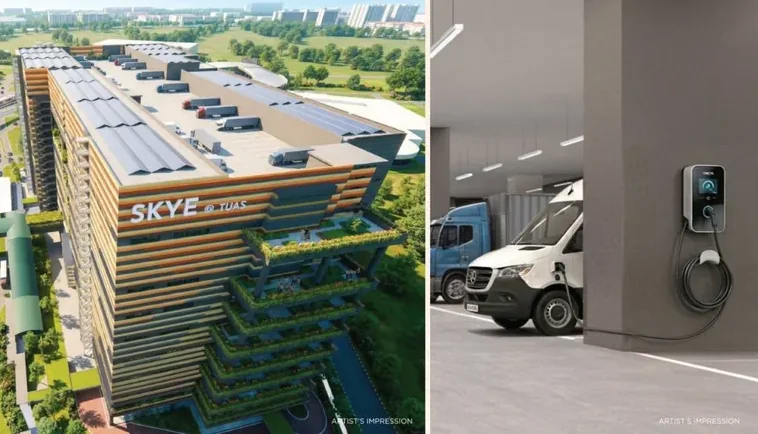
When expressways enter the marketing story, they are presented as an additional layer. Operationally, expressway access often helps with upstream and downstream distribution beyond the immediate port and industrial belt. But the main verified strengths still remain: rail adjacency and port closeness, backed by an address and access method that you can verify.
If you are comparing industrial spaces, the question becomes: which connectivity benefits reduce your cost of coordination and delay? Some businesses gain more from workforce commuting convenience. Others gain more from freight route options. Some gain from both, but only if internal building features support the workflow.
Unit planning and fit-out: making the “flexible layouts” claim work in practice
The verified material describes flexible industrial layouts aimed at production, logistics, warehousing, distribution, and manufacturing uses. It also references ramp-up access and high ceilings.
Your planning test should go one level deeper than “flexible.” Ask whether flexibility means your unit can be configured for rack heavy storage, whether equipment clearances align with the stated clear height range, and whether circulation supports both inbound receiving and outbound dispatch.
When reviewing a floor Plan, you can use the following shortlist as a guide, focused on how you would evaluate a space that must work on weekdays, not just during site visits.
- Confirm the clear height range relevant to the unit you are considering (not just the overall site range)
- Check what ramp-up access implies for your loading and staging sequence
- Look for whether the layout supports your storage and handling approach without creating bottlenecks
- Verify the 3-phase power supply tier listed for that unit against your equipment needs
- Ask the team how accessibility features support staff movement and visitor handling day-to-day
This approach keeps the evaluation anchored in specifications, accessibility, and operational flow.
Timing and decision rhythm: what “TOP in 2027” means for buyers
Skye Tuas is described with TOP in 2027. That timeline matters for your internal planning, especially if you are aligning relocation, fit-out lead times, and any schedule dependencies with suppliers or contractors.
If your business needs the space to be functional by a certain quarter, you should treat a projected TOP date as a milestone for planning, not a guarantee of immediate occupancy. During project Information discussions, ask how the marketing materials translate into practical steps for buyers and tenants: fit-out expectations, handover process timing, and when decisions become locked.
Because Skye Tuas is presented as a large development with 247 industrial units, plus commercial units and canteens, it also implies a broader staging and rollout structure. You do not need to guess the rollout pace. But you should ask the team what they can share about the sequence of availability, so your relocation plan does not hinge on optimistic assumptions.
The sensible takeaway on expressway connectivity
Skye Tuas marketing highlights expressway connectivity, alongside MRT access and proximity to Tuas Mega Port. The verified parts you can stand on include the address, the sheltered bridge access from Tuas Link MRT, the B2 industrial classification, the TOP and tenure, the unit counts, and the key building spec details that affect operational suitability.
Where expressway connectivity fits is as a supporting advantage, not the foundation. It is the kind of benefit that can help when you model real freight movement and daily scheduling, but it is difficult to validate through general marketing language alone.
So if you are considering Skye Tuas and you are planning a book appointment to discuss units, layouts, and specifications, treat “expressway connectivity” as a question to answer with your own route planning and operational needs. Pair that with the concrete evaluation you can do on clear height, power supply, and the way ramp-up access and high ceilings support your workflow.
If Skye Tuas’s internal capabilities line up with your equipment and storage approach, and if its external access matches how your people and trucks actually move, then the expressway narrative becomes more than a brochure line. It turns into a daily advantage you can feel long after the marketing meeting ends.